University Staff Resources

Resources for University Purchasers & Departments
The Office for Supplier Diversity is your partner in identifying high-quality, local, and small business suppliers. From navigating the Small Business Directory to refining your RFP outreach strategy, we provide the expertise to help you find the right partners for your project. We assist University staff in fostering an open and competitive bidding environment that benefits both the University and our surrounding communities.
Make a Purchase
University Purchasing Policies and Processes
Review Purchasing Services' policies and processes prior to making a purchase - https://purchasing.umn.edu/policy-and-process
Use the UMN Small Business Directory to Find New Vendors
Search Filters
- Search for Keywords, Product or Services, and many more to see what is to offer.

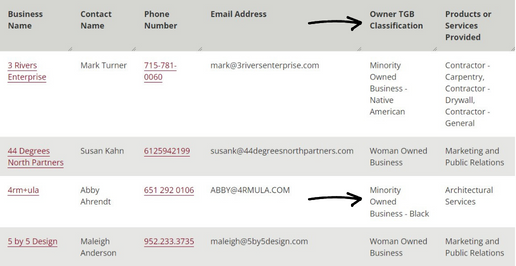
TGB Classification
- Looking through the directory, you will be able to see which classification each business is real time.
Add New Suppliers to EFS and Trirega
New suppliers who have never done business with the University of Minnesota must first be added to EFS and/or Trirega using the forms below.
If you are U of M staff and wish to work with a new small supplier, the Office for Supplier Diversity can fill out these forms for you. Please contact us at [email protected] to request assistance.
Complete and Submit Form ST3 (Certificate of Tax Exemption)
To help streamline the process of working with a new supplier, OSD can complete and submit Form ST3 (Certificate of Tax Exemption) on behalf of any University department or unit. We’ll send the form directly to the vendor in advance of your purchase.
To request this service, please contact [email protected] and provide the following information:
- Seller name
- Seller address, city, state, zip
Drafting an RFP
Tips for Drafting Inclusive & Competitive RFPs
1. Prioritize Clarity and Simplicity
Use Plain Language: Be as clear and concise as possible. Complex jargon can be a barrier to entry for smaller firms with fewer administrative resources.
Streamline Requirements: Limit the paperwork to what is absolutely necessary. Overly complex or heavy proposal requirements can discourage qualified small businesses from bidding.
2. Optimize the Bidding Timeline
Extend the Posting Period: Allow RFPs to remain open longer. This gives small businesses—who often wear many hats—the time needed to build a quality proposal or secure strong subcontracting partnerships.
Expand the Q&A Buffer: Provide more time between the release of final Q&A answers and the RFP due date. Smaller firms often need extra time to pivot their strategy or budget based on those answers.
3. Foster Transparency and Subcontracting
Include a Budget Range: Providing a realistic budget range helps businesses determine if they are a good fit. This prevents a "no-go" for the vendor and saves University staff time spent reviewing misaligned proposals.
Define Subcontractor Scopes: Explicitly list potential components of the project that could be subcontracted. This highlights specific opportunities for small businesses to partner with larger prime contractors.
Use Matchmaking Tools: For projects with substantial subcontracting potential (standard for Construction and A&E), request that an Online Matchmaking Form be added to the RFP to facilitate connections between primes and small vendors.
4. Design for Accessibility
"Unbundle" Large Projects: Consider breaking massive projects into smaller, specialized "lots." This allows small businesses to compete on the specific scopes they excel at, rather than being excluded by the scale of a project.
Allow Equivalents: Avoid being overly strict on specific brands or proprietary products. Allow for "equals" or equivalents to encourage innovation and cost-competitive alternatives.
5. Leverage OSD Expertise
Strategic Outreach: Contact the Office for Supplier Diversity (OSD) to identify new, qualified small suppliers to invite. Helping expand the University’s pool ensures we are seeing the best the market has to offer.
Information Sessions: Invite OSD to host a Zoom Information Session prior to the RFP release. These sessions help bridge the gap between University needs and vendor capabilities, ensuring higher-quality submissions.
Learn more about why supplier diversity is important and how you can get involved by inviting the Office for Supplier Diversity to present to your department/unit! Email your request to [email protected].